Online vs. In-Person Automotive Sales Training: Which Works Best?

Choosing an automotive sales training program involves more than comparing course formats. As a dealership owner, you need to consider how training will affect daily operations, employee performance, and your ability to maintain consistent sales standards.
Online automotive sales training allows employees to learn without leaving the dealership, while in-person training provides direct instruction and hands-on practice. Each format serves different business needs, and choosing the wrong approach can mean investing in training that fails to address your team's actual weaknesses.
Understanding where each format delivers the most value will help you make a more informed decision about your training investment.
What Is the Difference Between Online and In-Person Automotive Sales Training?
Online automotive sales training delivers instruction through digital platforms, including self-paced courses, recorded demonstrations, and live virtual sessions. Employees can access training from their workplace, allowing you to provide instruction without bringing everyone together physically.
In-person training takes place in a shared learning environment where instructors demonstrate techniques, observe participants, and guide practical exercises. Sessions may be conducted at your dealership or at a dedicated training facility.
The key distinction is how employees interact with instructors and practice new skills. Online programs are well suited to delivering structured information, while in-person sessions make it easier to evaluate communication skills and provide immediate behavioral feedback.
Benefits of Online Automotive Sales Training
1. Flexible Training Around Dealership Operations
Customer appointments, vehicle deliveries, and showroom activity make it difficult to schedule training during regular business hours. Online programs allow you to assign learning activities during designated periods without removing an entire sales team from daily operations.
This flexibility can help your dealership maintain customer coverage while employees develop their skills. It also gives managers more control over training schedules during busy periods.
2. Reduced Travel and Training Expenses
Sending employees to off-site workshops may involve transportation, accommodation, and other logistical costs. Online training eliminates many of these expenses, making it a practical option for businesses with limited training budgets or geographically dispersed locations.
However, you should compare the full cost of each program, including subscription fees, instructor access, and paid training time. The goal is to identify which investment provides the instruction and support your employees need.
3. Standardized Sales Processes
When employees receive instruction from different managers, inconsistencies can develop in how they handle inquiries, qualify prospects, and follow up with customers.
Online programs allow you to introduce common procedures and expectations across your sales department. This is particularly useful when onboarding employees or establishing consistent practices throughout a dealership group.
4. Convenient Access to Refresher Training
Salespeople may need to revisit specific techniques as they encounter new challenges. Digital lessons make it possible to review material without waiting for another scheduled workshop.
For example, a manager who notices inconsistent appointment-setting practices can assign a relevant refresher lesson and review how employees apply the technique afterward.
Limitations of Online Automotive Sales Training
Limited Observation of Sales Behavior
Self-paced courses can assess knowledge, but they may not reveal how employees behave during actual customer conversations. A salesperson might understand objection-handling principles yet struggle to apply them under pressure.
If your team needs behavioral coaching, look for online programs that include live practice, instructor feedback, or recorded role-playing assessments.
Dependence on Employee Accountability
Without direct supervision, employees may postpone lessons or complete them without fully engaging with the material. This can make it difficult to determine whether participation reflects meaningful learning.
To address this, establish completion expectations, schedule dedicated learning time, and require employees to demonstrate the skills covered in training.
Benefits of In-Person Automotive Sales Training
1. Realistic Sales Practice
In-person workshops allow employees to rehearse situations they regularly encounter, including trade-in objections, vehicle comparisons, and customers who hesitate to make a purchase.
These exercises provide a controlled environment where salespeople can test different approaches before using them with customers. This is especially useful when introducing new sales techniques or correcting ineffective habits.
2. Immediate, Individualized Coaching
During live exercises, instructors can observe how employees ask questions, listen to customers, present solutions, and respond to concerns.
They can then provide specific feedback and ask employees to repeat an exercise using the recommended adjustments. This direct observation makes in-person training valuable when performance problems involve communication or execution rather than a lack of information.
3. Opportunities to Identify Teamwide Problems
Bringing employees together can reveal operational issues that are difficult to recognize through individual training.
For example, role-playing exercises may show that salespeople use inconsistent methods for qualifying customers or that managers have different expectations for handling unsold showroom traffic.
These findings can help you identify where sales procedures need clarification, not just where individual employees need coaching.
Limitations of In-Person Automotive Sales Training
Scheduling and Staffing Requirements
Instructor-led sessions require employees to attend at specific times. If several salespeople participate simultaneously, your dealership may need to adjust shifts, redistribute appointments, or arrange additional customer coverage.
For larger businesses, dividing employees into smaller training groups can reduce disruption but may increase the number of sessions required.
Limited Access After the Session
Once an in-person workshop ends, employees may not have access to the same demonstrations, exercises, or instructor guidance.
Without supporting materials or a structured follow-up plan, important techniques can become difficult to recall. Before booking a workshop, ask what resources and post-training support are included.
Online vs. In-Person Automotive Sales Training: Side-by-Side Comparison
The comparison shows why delivery format should follow your training objectives. If employees need to learn a defined process, digital instruction may be sufficient. If they need to improve how they perform that process with customers, direct coaching may offer greater value.
Which Automotive Sales Training Format Fits Your Business?
For Dealerships Hiring New Salespeople
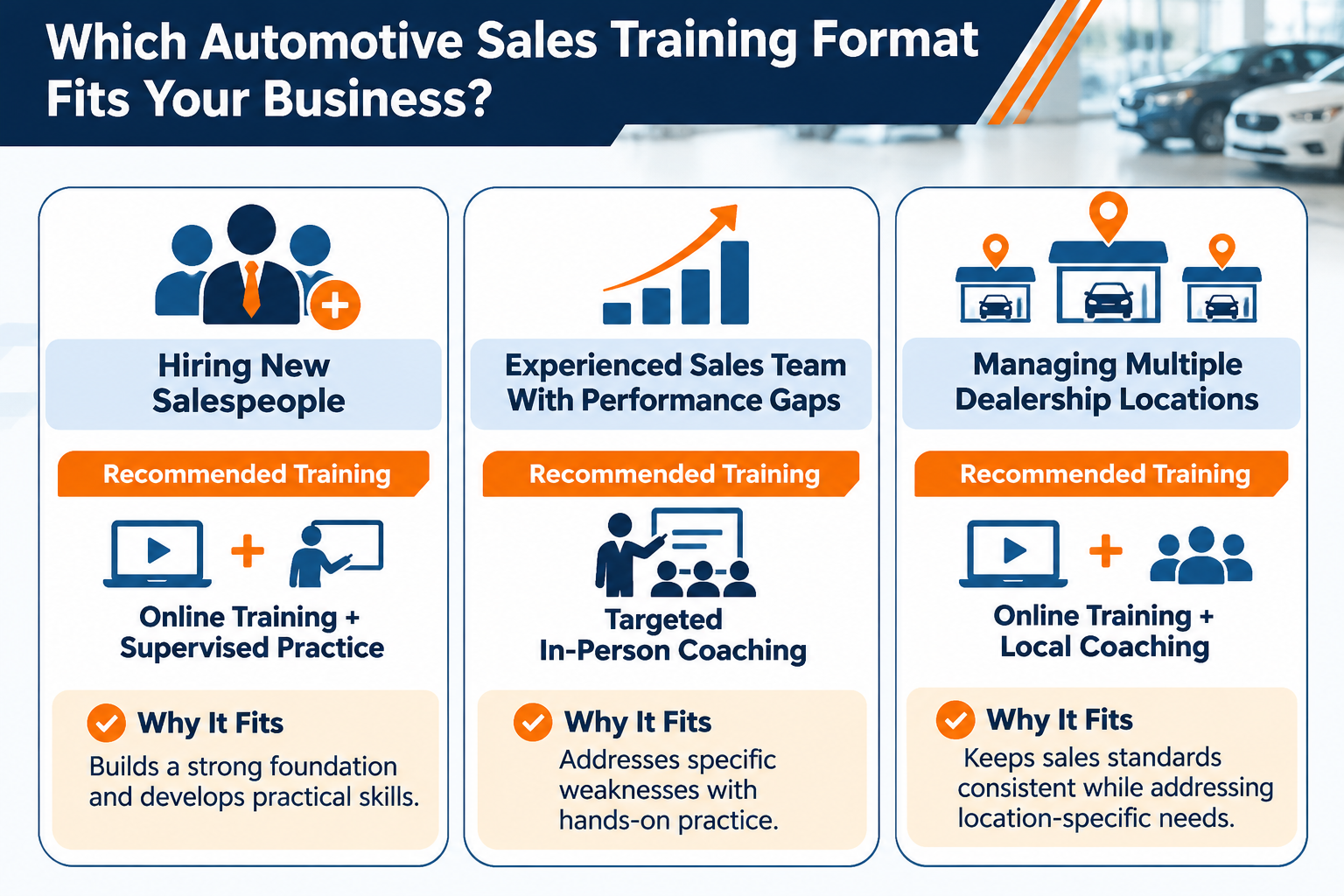
New hires need foundational knowledge before they can handle customer interactions independently. Online training can introduce your sales process, lead management procedures, and expectations for customer communication.
Once employees understand these requirements, supervised practice can help managers assess their readiness. This approach reduces the need to teach every concept individually while ensuring employees demonstrate essential skills before working independently.
For Dealerships With Experienced Sales Teams
Experienced employees may already understand your sales process but struggle with specific aspects of execution.
If appointment show rates are weak, for example, review how employees confirm appointments and communicate value to prospects. A targeted coaching session may be more useful than requiring the entire team to repeat introductory training.
The priority is to identify the performance gap before selecting a course.
For Multi-Location Dealership Groups
Operating several dealerships introduces challenges in maintaining consistent standards and monitoring employee development.
A centralized online curriculum can establish shared expectations, while location managers can address differences in employee performance and customer interactions.
This structure allows you to maintain common processes without assuming every dealership needs identical coaching.
When Does Blended Automotive Sales Training Make Sense?
Blended training combines online instruction with live coaching or instructor-led workshops. It is worth considering when employees need both foundational knowledge and opportunities to develop practical skills.
For example, your team could complete digital lessons on lead qualification before attending a workshop focused on appointment-setting conversations. Managers could then evaluate recorded calls or observe customer interactions to determine whether employees are applying the techniques.
The advantage is that each training activity serves a different function: online lessons introduce the process, live exercises develop execution, and management reviews reinforce performance.
Blended training does require additional coordination. Before adopting it, establish who will manage each stage and how employee progress will be evaluated.
How to Measure the Return on Your Automotive Sales Training Investment
Training should produce observable improvements in the activities it is designed to address. Before enrolling employees, identify the performance indicators most closely connected to your objectives.
For example, if your goal is to improve lead management, track response times, follow-up completion, and appointment-setting rates. If your focus is showroom performance, evaluate customer engagement, sales conversion, and closing rates.
Compare results before and after training, but account for factors such as inventory, lead quality, pricing, and seasonal demand. These variables can influence outcomes independently of employee performance.
You should also ask managers to observe whether employees consistently use the techniques taught. Improved knowledge is useful, but changes in customer-facing behavior provide stronger evidence that training is influencing daily operations.
How to Choose an Automotive Sales Training Provider
Once you understand which format suits your business, evaluate whether the provider can address your specific needs.
Consider the provider's automotive retail experience, curriculum, instructor qualifications, practical exercises, and assessment methods. Ask how the program accommodates your existing sales process and whether managers receive guidance on supporting employees afterward.
Clarify the full investment before committing, including course fees, employee time, travel requirements, and any additional coaching costs.
A suitable provider should be able to explain what employees will learn, how they will practice, and how your dealership can evaluate their progress.
Automotive Sales Training Options From ATN
Automotive Training Network (ATN) offers training options for automotive sales and business development center (BDC) teams, including virtual instruction, instructor-led boot camps, and in-dealership workshops.
Its training addresses areas such as phone communication, digital lead management, objection handling, and customer follow-up. These options give dealership owners different ways to develop employees based on their operational requirements and training priorities.
Explore Automotive Training Network to learn more about its available programs and discuss which training approach aligns with your business objectives.
Key Takeaways
- Online automotive sales training offers flexible scheduling, lower travel costs, and consistent instruction across dealership locations.
- In-person training provides hands-on practice, immediate feedback, and personalized coaching to improve sales execution.
- Online training works well for onboarding and skill refreshers, while in-person training is better suited to addressing specific performance gaps.
- Blended training combines structured online learning with practical coaching to support long-term skill development.
- The best training investment depends on your dealership's operational needs, employee skill gaps, and measurable performance goals.