How to Identify Sales Performance Gaps Before Investing in Dealership Training

Your dealership is generating leads, customers are visiting the showroom, and your sales team is staying busy. Yet too many opportunities fail to turn into completed sales. For dealership owners, the challenge is determining whether those missed opportunities result from weak sales skills, inconsistent processes, or operational problems that training alone cannot resolve.
Investing in dealership sales training without understanding the cause can waste resources and leave performance problems unchanged. Before selecting a program, owners should examine where customers disengage, how employees handle sales opportunities, and which weaknesses require structured skill development.
Examine Sales Performance Beyond Monthly Sales Figures
Monthly vehicle sales reveal overall results but not where opportunities are being lost. A salesperson may struggle because of poor lead quality, while another may receive qualified inquiries but fail to convert them into appointments.
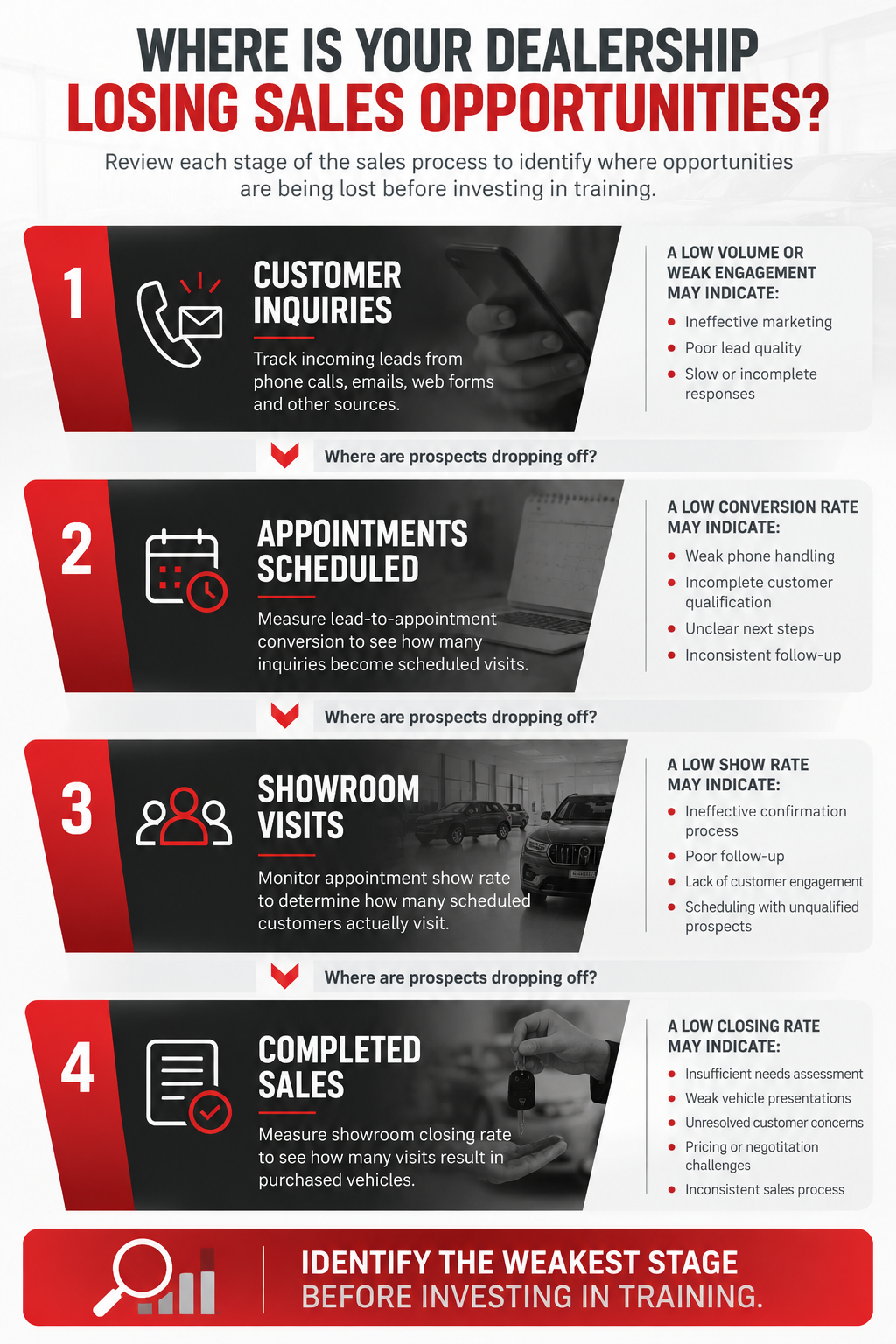
Review lead-to-appointment conversion, appointment show rates, and showroom closing rates. Compare results across employees while accounting for differences in lead quality, inventory, and customer demand. These measures help identify whether performance gaps involve prospect engagement, appointment setting, or showroom interactions.
Evaluate How Your Team Handles Customer Inquiries
Customer inquiries represent potential sales opportunities. Incomplete answers, delayed responses, and unclear next steps can prevent interested buyers from progressing toward a purchase.
Review recorded calls where legally permitted, emails, and customer relationship management (CRM) records for weaknesses in qualification, objection handling, and appointment setting. Consistency across communication channels matters: Cox Automotive's 2025 Car Buyer Journey Study found that 63% of surveyed buyers preferred a combination of online and in-person purchasing activities.
Repeated communication weaknesses may justify training. However, if employees cannot respond promptly because of poor lead assignments or excessive workloads, operational improvements should come first.
Identify Inconsistencies in the Showroom Sales Process
Inconsistent sales approaches can make it difficult to maintain service standards and understand why some employees convert more opportunities than others. One salesperson may conduct a thorough needs assessment, while another immediately begins presenting vehicles.
Observe how employees identify customer needs, demonstrate vehicles, and address concerns. The Cox Automotive Drivers of Car Shopping Satisfaction study identifies knowledgeable staff, transparency, and informed customers as important contributors to purchase satisfaction.
Compare these interactions against your dealership's standards. Employees who lack essential sales skills may need training, while those who understand the process but disregard it may need stronger management oversight.
Review Follow-Up and Appointment-Setting Performance
Missed follow-ups, weak appointment confirmations, and poorly handled objections can prevent interested prospects from reaching the showroom. These problems may remain unnoticed when dealerships focus primarily on new lead volume.
Examine CRM activity, appointment-setting rates, and appointment attendance. Review actual customer conversations rather than relying solely on call counts or completed tasks. If employees consistently struggle to secure appointments, targeted coaching may help. However, inaccurate CRM records, unclear lead assignments, or staffing shortages require operational solutions.
Distinguish Training Needs From Management Problems
Poor sales performance does not always indicate inadequate skills. Employees may understand the dealership's sales process but fail to apply it because expectations are unclear or managers do not consistently reinforce them.
Ask managers to observe specific sales behaviors and compare them with established standards. Employees who cannot demonstrate required skills may benefit from structured training. Those who know the process but repeatedly ignore it may need clearer accountability and ongoing supervision.
Before investing, ensure managers can reinforce new skills through observation, feedback, and regular coaching.
Prioritize Training Based on Business Impact
Not every performance gap requires immediate attention. Dealership owners should prioritize problems based on how frequently they occur, how many sales opportunities they affect, and whether training can address the underlying cause.
For example, low appointment-setting rates may justify phone skills training, while strong appointment attendance paired with weak showroom conversion may indicate a need for better needs assessments or vehicle demonstrations.
Once the most significant gaps are identified, focus training on the skills that directly influence those outcomes. Whether the priority is outbound prospecting, customer communication, or digital lead management, targeted instruction helps dealerships allocate resources effectively and address weaknesses without unnecessarily disrupting daily operations.
Establish Benchmarks Before Investing in Training
Training effectiveness is difficult to assess without reliable starting measurements. Before scheduling instruction, establish performance benchmarks that correspond to the skills being developed.
For phone training, monitor call quality, appointment-setting rates, and appointment attendance. For showroom training, evaluate customer interactions and closing rates. Compare results after training while accounting for changes in lead volume, inventory, and market conditions.
Managers should also observe whether employees consistently apply new skills. Combining behavioral assessments with performance data provides a clearer picture of progress than vehicle sales totals alone.
Make Dealership Training a Targeted Business Investment
Identifying sales performance gaps helps dealership owners determine whether training is the right solution and where resources should be directed. Reviewing conversion rates, customer interactions, and employee behaviors can reveal weaknesses that monthly sales reports overlook.
When performance problems stem from skill deficiencies, training should address those specific needs and include measurable goals and management reinforcement. When operational issues or inconsistent accountability are responsible, correcting those problems first can prevent unnecessary training expenses and support more sustainable improvements.
Turn Identified Performance Gaps Into a Focused Training Plan
Identifying sales performance gaps helps dealership owners determine where employee development can make a meaningful difference. Once you understand which skills need improvement, the next step is choosing training that addresses those specific challenges without disrupting daily operations unnecessarily.
Automotive Training Network (ATN) works with dealerships to develop sales capabilities through practical, in-dealership instruction. If your assessment reveals recurring weaknesses in customer communication, appointment setting, or showroom processes, ATN can be a resource for exploring training options that align with your dealership's priorities.
Key Takeaways
- Look beyond sales totals. Review conversion rates, appointment attendance, and customer interactions to identify lost opportunities.
- Evaluate employee performance. Examine phone handling, follow-up practices, and showroom interactions to uncover skill gaps.
- Separate training needs from operational issues. Determine whether poor results stem from inadequate skills, unclear processes, or weak management accountability.
- Prioritize high-impact weaknesses. Focus training resources on problems that affect the most sales opportunities.
- Measure training effectiveness. Establish performance benchmarks and monitor employee progress.