
How Can Dealership Sales Teams Manage Electric Vehicle Sales?
Electric vehicle adoption continues to accelerate, and dealerships must adapt to this shift in order to stay competitive. Industry forecasts estimate that electric vehicles will account for about 27.5% of global vehicle sales in 2026, highlighting the rapid pace at which electrification is reshaping the market and creating new opportunities for dealerships worldwide.
For dealership sales teams, this presents both opportunity and complexity. EV buyers often come to the showroom informed and expect sales professionals to address range, charging, incentives, and long-term ownership considerations with confidence and clarity. Unlike conventional vehicles, EVs require a different sales approach, one that balances technical information with customer priorities and builds trust throughout the purchase process.
In this blog, we’ll understand practical tips for managing electric vehicle sales, from enhancing product knowledge and customer engagement to optimizing your sales process, so your team can confidently engage EV buyers and turn interest into sales.
The Unique Challenges of EV Sales
One of the most common challenges is range anxiety. Customers want reassurance that an EV fits their daily driving habits, yet many sales conversations stall when range is discussed in abstract numbers rather than real-world use. Charging concerns follow closely behind, especially for buyers unfamiliar with home charging options or public infrastructure.
EV pricing also introduces complexity. While long-term ownership costs are often lower, the upfront price can feel higher to customers who are new to EVs. Sales teams must clearly explain incentives, operating savings, and ownership differences without overwhelming the buyer. This requires confidence and clarity rather than speed.
Finally, EV sales demand deeper product understanding. Battery technology, charging speeds, software updates, and maintenance differences all come into play. Without proper preparation, sales professionals may hesitate or oversimplify, which can weaken trust. Recognizing these challenges is the first step toward building an EV sales approach that feels informed, supportive, and credible to today’s buyers.
Tips for Dealership Sales Teams To Manage Electric Vehicle Sales
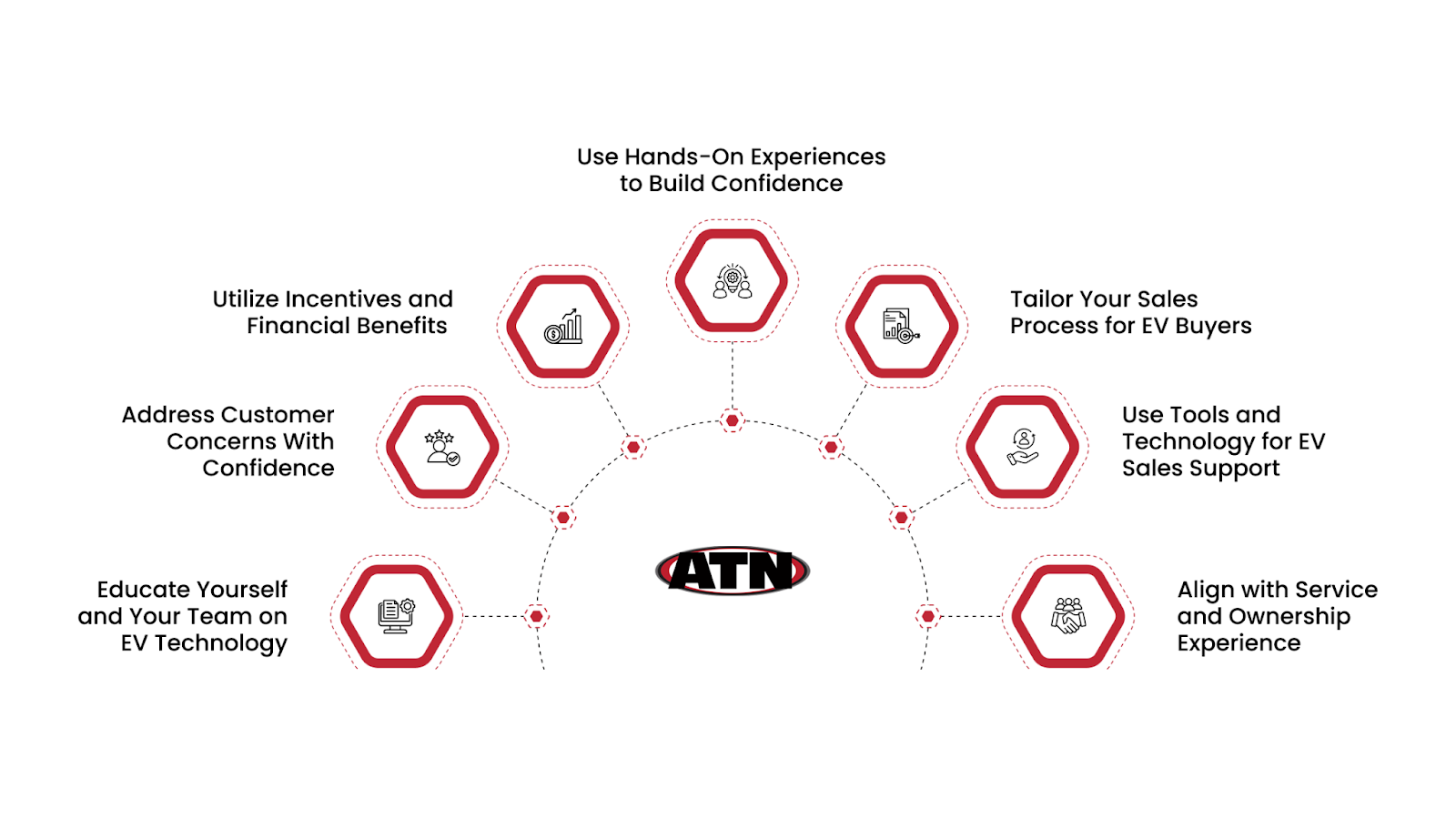
Electric vehicle buyers bring different questions, expectations, and priorities into the showroom. Managing EV sales successfully requires a consultative approach that blends product knowledge, clear communication, and confidence. The tips below help dealership sales teams engage EV buyers more effectively and guide conversations that turn curiosity into commitment.
1. Educate Yourself and Your Team on EV Technology
EV buyers expect sales professionals to understand the technology behind the vehicle, not just the features on the window sticker. Education is foundational to managing EV sales confidently and building trust during the buying process.
Sales teams need a working understanding of how EVs differ from internal combustion vehicles and how those differences affect daily ownership. Conversations often go beyond horsepower and trim levels into topics like battery life, charging speeds, software updates, and long-term maintenance expectations. Without that knowledge, even strong sales skills can fall short.
Effective EV education should focus on:
- Battery fundamentals: Range variations, charging cycles, and what impacts real-world performance
- Charging options: Home charging setups, public charging networks, and fast-charging capabilities
- Ownership differences: Reduced maintenance needs, regenerative braking, and driving experience changes
- Technology updates: Software features and how updates improve performance over time
When sales professionals feel confident explaining how EV technology works in practical terms, conversations become more consultative and less transactional. That confidence reassures buyers and generates true leads.
2. Address Customer Concerns With Confidence
EV buyers often arrive with questions that can slow or stall a decision if they’re not handled clearly. Concerns around range, charging access, battery longevity, and ownership costs are common, and how these topics are addressed can shape the entire buying experience.
Confidence comes from translating technical details into a real-life context. Rather than quoting specifications alone, effective sales conversations connect EV capabilities to how customers actually drive and live.
Sales teams can address concerns more effectively by:
- Putting range into perspective: Relating range to daily commutes, errands, and typical driving habits
- Explaining charging simply: Outlining home charging options and realistic public charging use
- Clarifying ownership costs: Discussing long-term savings without overwhelming the buyer
- Answering questions calmly: Creating space for discussion rather than rushing to close
When sales professionals handle EV concerns with clarity and assurance, buyers feel supported rather than pressured. That confidence builds trust and keeps the conversation moving forward.
3. Utilize Incentives and Financial Benefits
Incentives play a major role in EV buying decisions, yet many customers feel unsure about how they work or whether they apply to them. Sales teams that can clearly explain financial benefits help remove hesitation and make EV ownership feel more attainable.
EV incentives often change by region, manufacturer, and buyer eligibility, so staying current is essential. When handled well, these conversations shift focus away from sticker price and toward overall value.
Sales teams can use incentives more effectively by:
- Explaining available programs clearly: Walking customers through federal, state, or OEM incentives in plain language
- Connecting incentives to affordability: Showing how credits or rebates reduce upfront or monthly costs
- Highlighting operating savings: Discussing fuel and maintenance savings over time in practical terms
- Setting realistic expectations: Clarifying eligibility requirements to avoid confusion later
When incentives are presented confidently and accurately, buyers gain a clearer picture of total ownership value. That clarity helps EV conversations feel informed and reassuring rather than complicated or uncertain.
4. Use Hands-On Experiences to Build Confidence
EV buyers gain confidence when they can experience the vehicle rather than just hear about it. Hands-on interaction helps demystify the technology and allows customers to see how an EV fits into their daily routine.
Test drives, charging demonstrations, and feature walk-throughs turn abstract concerns into tangible understanding. Feeling how an EV accelerates, regenerates energy, or displays charging information often answers questions more effectively than explanations alone.
Sales teams can build confidence through:
- Extended test drives: Giving customers time to experience EV performance and comfort
- Charging demonstrations: Showing how home or public charging works in real time
- Feature walk-throughs: Explaining dashboards, energy displays, and driver assistance systems
- Real-world examples: Relating the experience back to daily driving scenarios
When customers engage directly with an EV, uncertainty fades, and confidence grows. Hands-on experiences help buyers move from curiosity to comfort, making the decision process smoother and more natural.
5. Tailor Your Sales Process for EV Buyers
EV buyers often follow a different decision path than traditional vehicle shoppers. They tend to research extensively, compare ownership scenarios, and focus on long-term use rather than immediate features alone. A flexible, consultative sales process helps meet these expectations.
Rather than rushing conversations, successful EV sales focus on discovery and education. Understanding how a customer plans to charge, drive, and use the vehicle allows sales professionals to guide the discussion more effectively.
Sales teams can tailor their process by:
- Asking lifestyle-based questions: Learning about daily driving habits, home setup, and charging access
- Pacing the conversation: Allowing time for questions and education before moving toward commitment
- Integrating EV education early: Addressing common concerns upfront instead of waiting for objections
- Aligning next steps: Offering test drives, follow-up conversations, or resources that support informed decisions
When the sales process reflects how EV buyers think and decide, conversations feel more supportive and less transactional. That alignment builds trust and increases the likelihood of long-term customer satisfaction.
6. Use Tools and Technology for EV Sales Support
EV sales conversations are more effective when supported by clear, visual, and easy-to-use resources. Tools and technology help sales teams explain complex concepts, compare options, and guide buyers toward confident decisions without overwhelming them.
The right support tools turn education into clarity. They allow sales professionals to focus on the customer rather than searching for answers mid-conversation.
Sales teams can strengthen EV sales support by using:
- EV comparison tools: Side-by-side range, charging time, and cost comparisons that simplify decision-making
- Charging locator apps: Showing nearby public charging options to ease infrastructure concerns
- Ownership calculators: Estimating fuel and maintenance savings to highlight long-term value
- Digital walk-throughs: Visual aids that explain charging, energy usage, and vehicle features
- CRM documentation: Tracking EV-specific questions and follow-ups to personalize future conversations
When technology supports the conversation, sales professionals stay confident, and customers stay engaged. These tools help transform complex EV information into practical guidance that moves the buying process forward.
7. Align with Service and Ownership Experience
A successful EV sale doesn’t end when the vehicle leaves the lot. EV buyers place high value on what ownership will look like after delivery, which makes alignment between Sales and Service essential.
Sales teams who understand the EV ownership experience can set accurate expectations and create a smoother transition into service. This alignment reassures buyers that support continues well beyond the purchase.
Sales teams can strengthen alignment by:
- Understanding EV service differences: Explaining reduced maintenance needs, software updates, and battery health checks clearly
- Coordinating with Service teams: Ensuring consistent messaging around maintenance schedules and support
- Preparing customers for ownership: Walking buyers through what their first service interaction will look like
- Supporting long-term confidence: Reinforcing that the dealership is equipped to service and support EVs
When sales and service work together, customers feel supported rather than handed off. That continuity builds trust, improves satisfaction, and increases the likelihood of repeat business and referrals.
Prepare Your Sales Team for the Realities of EV Selling With Automotive Training Network
Electric vehicle sales demand a different level of preparation, confidence, and communication. Automotive Training Network helps dealerships equip their sales teams with the skills needed to guide EV conversations clearly and credibly, without relying on generic talking points.
ATN’s customer-first training approach focuses on real showroom interactions, practical education, and consultative selling techniques that align with how EV buyers research and decide. By reinforcing EV knowledge, ownership conversations, and cross-team alignment, ATN helps sales professionals feel prepared rather than reactive.
Dealerships working with Automotive Training Network gain:
- EV-focused sales training: Practical guidance that supports informed, confident EV conversations
- In-dealership and virtual delivery options: Training aligned with daily operations and team schedules
- Hands-on coaching: Real-world scenarios that reflect modern EV buyer expectations
- Stronger alignment across teams: Clear communication between Sales, BDC, and Service
- Decades of dealership experience: Training shaped by real dealership environments worldwide
If your dealership is ready to move beyond surface-level EV knowledge and build genuine buyer confidence, Automotive Training Network is ready to help.
Start preparing your sales team for the future of EV selling today.