How Can Dealer Principals Use Accounting to Drive Profitability and Improve Performance?

You cannot run a dealership today with just a strong sales performance. Financial clarity has become just as important as inventory, pricing, and customer experience. Dealerships operate across multiple revenue streams, including vehicle sales, F&I, service, and parts, each with its own cost structure and profit margins. Without a clear understanding of how these areas perform financially, it becomes difficult to identify where the business is gaining or losing money.
The numbers make this even more important. Industry data shows that fixed operations account for approximately 60% of a dealership’s net profit, despite contributing a much smaller share of total revenue. Profitability is not always where it appears on the surface, and understanding financial statements is essential to making the right decisions.
Dealership accounting is also more complex than conventional business accounting. It involves managing high-value inventory, floorplan financing, multiple income sources, and detailed departmental reporting. For dealer principals and owners, understanding these financial fundamentals is not optional. It is a core leadership responsibility.
In this blog, we will break down the crucial components of dealership accounting and how to use them to improve performance and profitability.
Why Is Accounting Knowledge Essential for Dealer Principals?
Strong leadership in a dealership is closely tied to financial understanding. Every major decision, including pricing, hiring, inventory levels, or expansion, has a direct financial impact. Without a clear grasp of dealership accounting, principals risk making decisions based on assumptions rather than accurate data, which can quickly affect profitability and long-term stability.
Common reasons accounting knowledge is essential include:
- Decision-making foundation: Financial data provides the clarity needed to make informed, confident business decisions rather than relying on instinct alone.
- Visibility across departments: Understanding financials helps identify which areas, such as sales, F&I, service, or parts, are driving profit and which need improvement.
- Better cash flow management: Clear insight into income and expenses helps maintain liquidity and avoid operational disruptions.
- Improved inventory and expense control: Financial awareness supports smarter inventory management and helps keep costs aligned with revenue.
- Reduced reliance on guesswork: Accurate reporting replaces assumptions with measurable performance, improving overall control.
- Support for strategic planning: Financial insights guide long-term decisions such as expansion, investments, and resource allocation.
When dealer principals understand their numbers, they gain control over both daily operations and long-term direction. This clarity leads to better decisions, stronger performance, and a more resilient dealership.
Main Components of Dealership Accounting
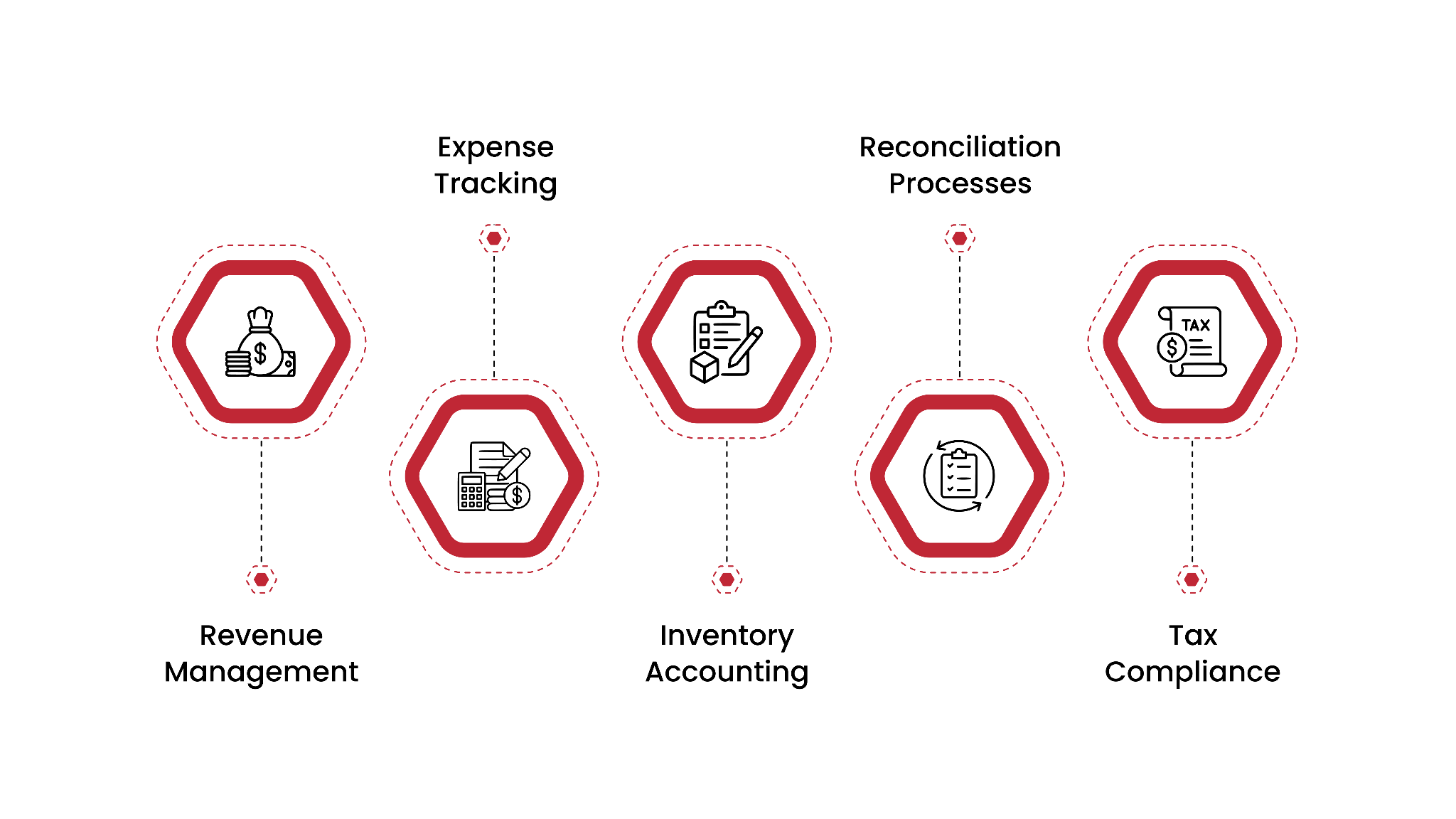
Dealership accounting involves multiple moving parts, each requiring accuracy and consistency. From tracking revenue streams to managing inventory and compliance, every component plays a role in overall financial performance.
Revenue Management
Revenue in a dealership comes from several sources, and each must be tracked separately to maintain clarity and accuracy.
Major areas include:
- Vehicle sales: Recording income from new and used vehicles, including pricing, incentives, commissions, and discounts.
- Parts and accessories: Monitoring sales of parts to ensure proper categorization and tax handling.
- Service and repair income: Capturing revenue from maintenance, warranty work, and repairs while accounting for labor and materials.
- F&I products and add-ons: Tracking income from extended warranties, financing products, and protection plans.
Accurate revenue tracking helps identify profit drivers, supports forecasting, and highlights areas for improvement.
Expense Tracking
Dealerships operate with a wide range of expenses that must be monitored closely to protect profitability.
Important categories include:
- Operational expenses: Costs such as rent, utilities, and facility maintenance.
- Payroll and compensation: Wages, commissions, bonuses, and benefits across all departments.
- Marketing and advertising: Spending on campaigns, digital ads, and promotions.
- Cost of goods sold (COGS): The cost associated with vehicles, parts, and inventory sold.
Consistent expense tracking ensures better cost control and supports more informed financial decisions.
Inventory Accounting
Inventory represents one of the largest financial investments in a dealership and must be managed carefully.
Primary considerations include:
- Valuation methods: Using approaches such as FIFO, LIFO, or specific identification to determine inventory value.
- Vehicle tracking: Monitoring acquisition costs, depreciation, and current market value for new and used inventory.
- Parts management: Balancing stock levels to avoid excess carrying costs or shortages.
- Physical counts and reconciliation: Regular checks to ensure inventory records match actual stock.
Strong inventory management supports accurate reporting and improves overall profitability.
Reconciliation Processes
Reconciliation ensures that financial records remain accurate and aligned across all accounts and departments.
Critical areas include:
- Bank reconciliation: Matching dealership records with bank statements to identify discrepancies.
- Floorplan financing tracking: Ensuring inventory financing and interest costs are recorded correctly.
- Cross-department alignment: Verifying that sales, service, and parts records are consistent.
Regular reconciliation reduces errors, strengthens financial control, and supports audit readiness.
Tax Compliance
Dealerships must manage a range of tax obligations while maintaining accurate records and filings.
Major responsibilities include:
- Sales tax management: Tracking and reporting taxes on vehicle and parts sales.
- Payroll tax obligations: Calculating and remitting employee-related taxes.
- Income tax reporting: Preparing returns and applying deductions such as depreciation and operating expenses.
- Regulatory requirements: Handling reporting obligations for large cash transactions and other compliance standards.
Proper tax management helps avoid penalties, ensures compliance, and supports smooth financial operations.
Financial Statements Every Dealer Principal Should Understand
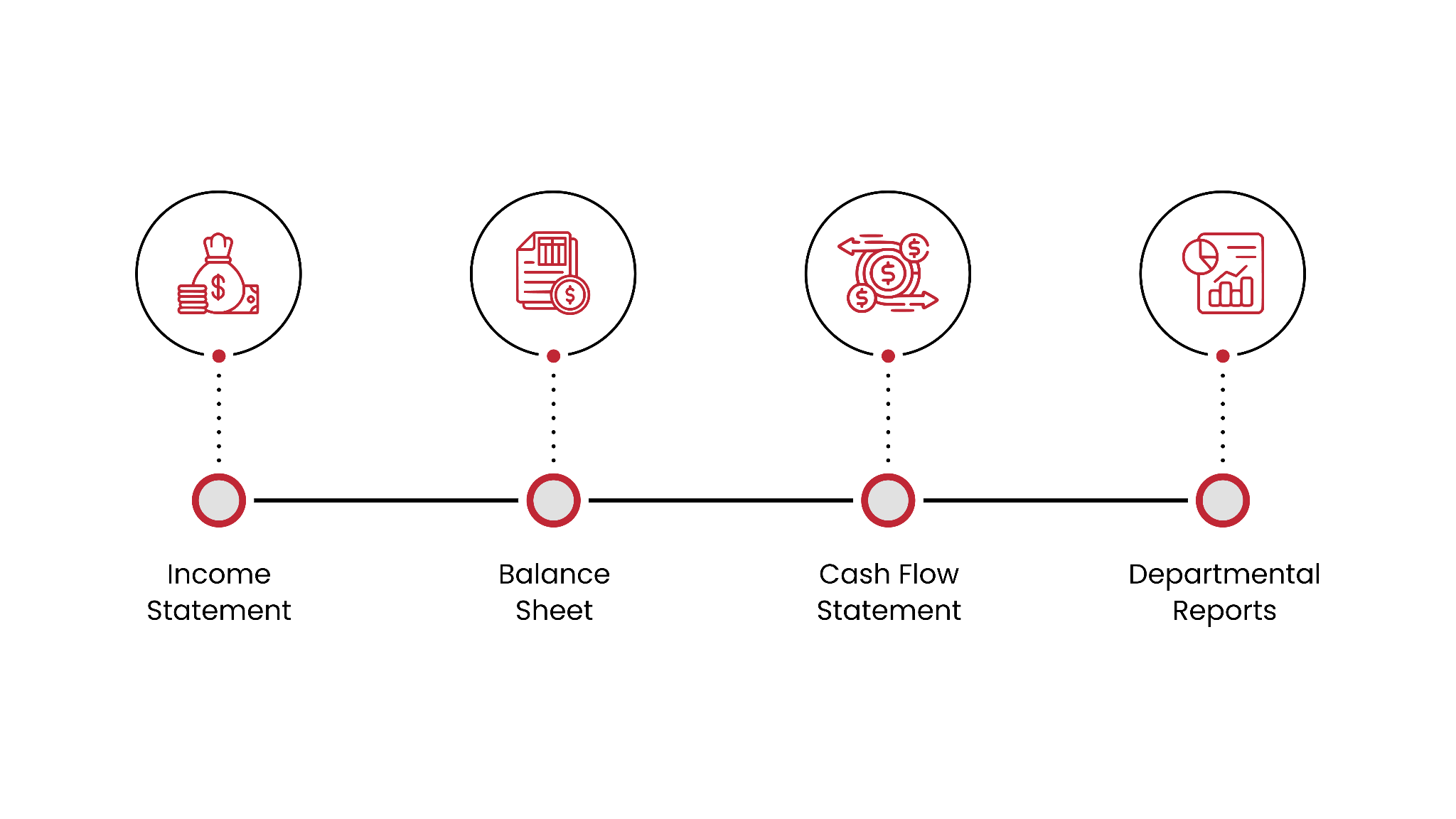
Dealership financials are more complex than those of most businesses. Multiple revenue streams, high-value inventory, floorplan financing, and departmental performance all need to be tracked and analyzed together.
Relying on a single report does not provide a complete picture of selling challenges. Dealer principals need to understand how different financial statements work together to reveal true profitability and operational performance.
Income Statement
The profit and loss statement provides a detailed view of the dealership’s performance over a specific period. It outlines total revenue, expenses, and net profit, making it one of the most frequently reviewed financial reports.
Important insights include:
- Revenue tracking: Shows income generated across all departments over time.
- Departmental performance: Breaks down results across sales, service, parts, and F&I, helping identify profit drivers.
- Expense visibility: Highlights where money is being spent and where cost control may be needed.
- Trend identification: Reveals patterns in profitability, allowing leaders to make adjustments proactively.
A well-understood P&L helps dealer principals quickly assess where the dealership is performing well and where improvements are needed.
Balance Sheet
The balance sheet provides a snapshot of the dealership’s financial position at a specific point in time. It outlines what the dealership owns, what it owes, and the overall equity in the business.
Important components include:
- Assets: Includes inventory, receivables, cash, and other resources owned by the dealership.
- Liabilities: Covers obligations such as floorplan financing, loans, and payables.
- Equity position: reflects the business's overall financial strength.
This statement helps dealer principals evaluate financial stability, manage risk, and understand how well the dealership is positioned for growth.
Cash Flow Statement
Profitability does not always equal cash availability. The cash flow statement tracks how money moves in and out of the dealership, making it essential for maintaining daily operations.
Major areas to monitor include:
- Cash inflows: Revenue collected from vehicle sales, service, and other operations.
- Cash outflows: Payments for inventory, expenses, payroll, and financing obligations.
- Liquidity management: Ensures there is enough cash available to meet operational needs.
Understanding cash flow helps prevent situations where a dealership appears profitable on paper but struggles to cover expenses.
Departmental Reports
Departmental reports provide deeper detail by breaking down performance across different areas of the dealership. This level of visibility is critical for identifying strengths and weaknesses.
These reports help:
- Track profitability by department: Compare performance across sales, service, parts, and F&I.
- Identify high-performing areas: Highlight departments that are driving strong results.
- Pinpoint underperformance: Reveal areas that require attention or operational changes.
By regularly reviewing departmental performance, dealer principals can make targeted improvements that directly impact overall profitability.
How to Read and Interpret a Dealer Financial Statement
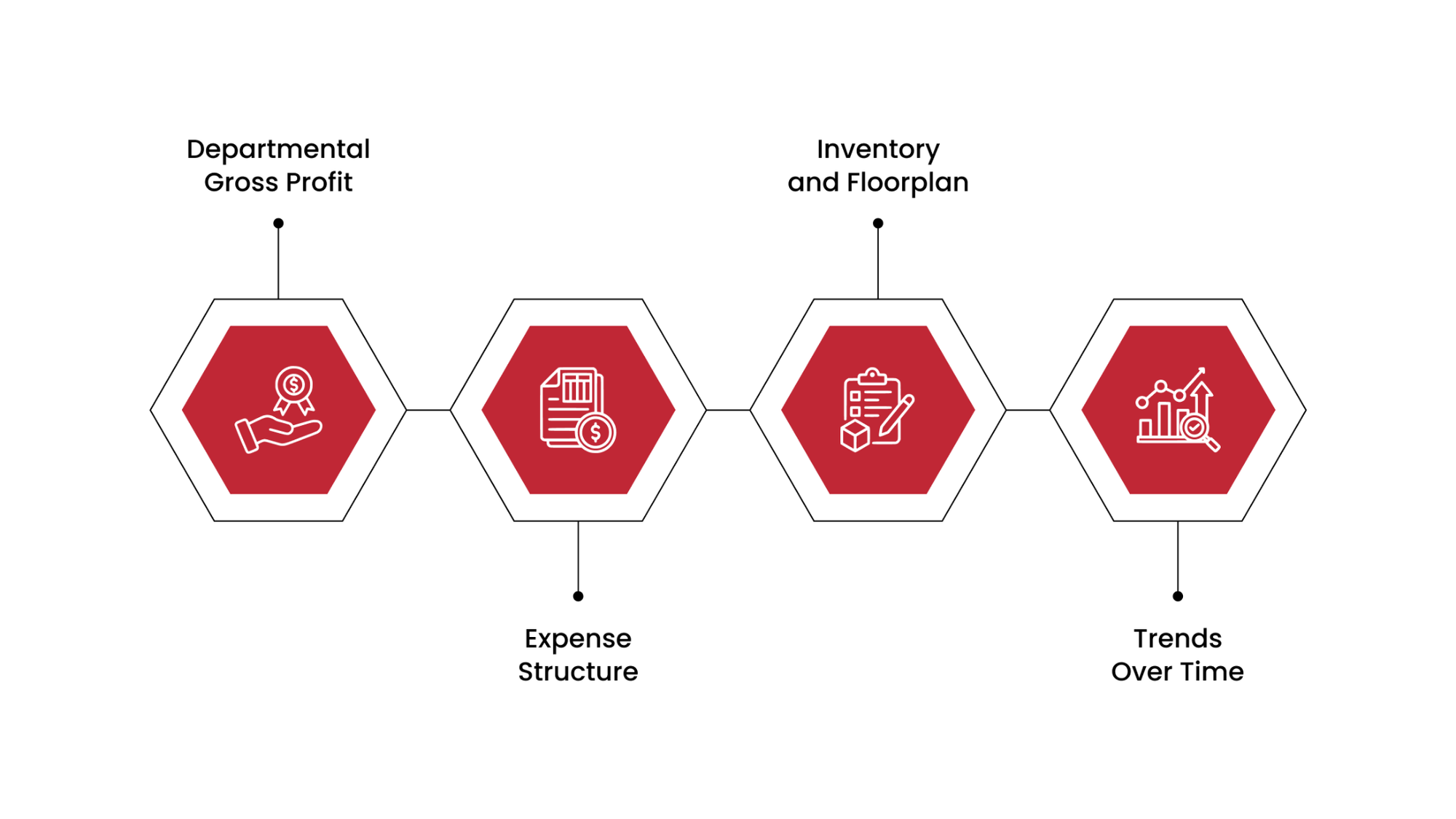
A dealer's financial statement is more than a report. It is a standardized monthly snapshot of the dealership's performance across all departments. When reviewed correctly, it highlights where profit is being generated, where costs are rising, and where corrective action is needed. The value lies in knowing what to focus on and how to connect the numbers to real operational decisions.
Departmental Gross Profit
Understanding where gross profit comes from is essential for evaluating dealership performance. Each department contributes differently, and those differences reveal where the business is strongest.
Primary areas to review include:
- New vs used vehicle performance: Compare margins and volume to understand which segment is contributing more effectively.
- Service and parts contribution: Evaluate how fixed operations are supporting overall profitability.
- F&I performance: Assess income generated per deal and its impact on total gross.
A clear view of departmental gross profit helps prioritize focus and allocate resources effectively.
Expense Structure
Expenses can quietly reduce profitability if they are not monitored closely. A detailed review of costs helps identify areas where spending may be out of alignment with revenue.
Focus on:
- Rising expense categories: Identify departments or areas where costs are increasing over time.
- Fixed vs variable expenses: Understand which costs remain constant and which scale with business activity.
- Expense-to-gross ratio: Evaluate whether expenses are proportionate to the revenue being generated.
Managing expenses effectively ensures that revenue growth translates into actual profit.
Inventory and Floorplan
Inventory is one of the largest investments in a dealership, and how it is managed directly impacts profitability. Floorplan costs add another layer of financial pressure that must be monitored consistently.
Important factors include:
- Aging inventory: Identify vehicles that are sitting too long and tying up capital.
- Turn rate: Measure how quickly inventory is being sold and replaced.
- Floorplan interest costs: Track how financing impacts overall profitability.
Efficient inventory management reduces unnecessary costs and improves cash flow.
Trends Over Time
Looking at a single month in isolation does not provide enough insight. Performance should always be evaluated over time to identify patterns and make informed decisions.
Major comparisons include:
- Month-over-month performance: Track short-term changes and identify immediate issues.
- Year-over-year trends: Compare current performance against previous periods to measure growth or decline.
- Seasonal patterns: Recognize recurring fluctuations that impact sales and service activity.
Trend analysis helps dealer principals move beyond reactive decisions and take a more strategic approach to improving performance.
Common Accounting Mistakes Dealerships Make
Even well-performing dealerships can lose profitability due to avoidable accounting mistakes. These issues often go unnoticed until they begin to impact cash flow, reporting accuracy, or overall financial performance. Identifying and correcting these gaps helps dealer principals maintain control and make more informed decisions.
Common mistakes include:
- Delayed financial reporting: Late or outdated reports limit visibility and lead to decisions based on incomplete information.
- Inaccurate inventory accounting: Mismatches between physical inventory and financial records create distorted profit and asset values.
- Ignoring departmental profitability: Focusing only on total revenue instead of understanding where profit is actually generated.
- Poor expense tracking: Costs are not monitored closely, leading to unnecessary spending and reduced margins.
- Overlooking cash flow management: Profit may look strong on paper, while cash availability becomes constrained.
- Lack of reconciliation processes: Accounts are not reviewed regularly, increasing the risk of errors and discrepancies.
- Limited financial understanding at the leadership level: Over-reliance on accounting teams without fully understanding the numbers.
Avoiding these mistakes requires consistent processes, accurate reporting, and a clear understanding of how financial data connects to daily dealership operations.
Car Dealership Accounting Checklist
Maintaining financial accuracy requires consistent review and discipline. Dealer principals and general managers can use the following checklist to ensure that accounting processes remain accurate, transparent, and aligned with dealership performance.
Consistently following this checklist helps maintain accurate financial records, reduce risk, and support stronger decision-making across the dealership.
Equip Your Team With Financial Clarity to Drive Dealership Growth with Automotive Training Network

Strong accounting practices start with a team that understands how dealership financials work in real-world conditions. Automotive Training Network’s accounting training goes beyond theory, helping your financial team build the skills needed to improve accuracy, efficiency, and overall performance.
ATN’s programs are built specifically for dealership environments, covering everything from foundational accounting principles to advanced financial analysis. Each training is tailored to your store’s operations, ensuring your team can apply what they learn immediately.
With ATN accounting training, your dealership can benefit from:
- Industry-specific financial expertise: Training focused on the unique structure of dealership accounting
- Stronger financial reporting: Improved accuracy in balance sheets, income statements, and cash flow tracking
- Better operational efficiency: Streamlined processes that support faster and more reliable reporting
- Improved compliance and risk management: Clear understanding of regulations, reporting standards, and ethical practices
- Practical, hands-on learning: Real dealership scenarios, case studies, and exercises that reinforce application
Dealerships that invest in accounting training gain more than accurate reports. They gain the ability to make confident decisions, improve profitability, and maintain control over every aspect of their financial performance.
If you are ready to strengthen your dealership’s financial operations, explore ATN’s accounting training programs.
Frequently Asked Questions
1. How often should dealer principals review dealership financial statements?
Dealer principals should review financial statements at least monthly, with weekly check-ins on key metrics. Regular reviews help identify issues early and maintain control over performance.
2. What makes dealership accounting different from other businesses?
Dealership accounting involves multiple revenue streams, high-value inventory, and floorplan financing. This adds complexity compared to standard business accounting models.
3. What is a dealer statement, and why is it important?
A dealer statement is a standardized financial report that shows monthly performance across all departments. It helps track profitability, expenses, and overall dealership health.
4. How can inaccurate accounting impact dealership profitability?
Inaccurate accounting can lead to poor decisions, unnoticed losses, and cash flow issues. Even small errors can significantly affect overall profitability over time.
5. Who should be involved in dealership accounting processes?
While the accounting team manages daily reporting, dealer principals, general managers, and department heads should understand and review financial data regularly.