Better People, Better Processes: The Value of Automotive Training and Consulting

Running a dealership means relying on your people every day. Your sales team represents your store on the showroom floor. Your service advisors shape the customer experience long after the vehicle is sold. Your business development center (BDC) handles opportunities that can easily be won or lost before a customer ever walks through the door. And your managers are responsible for keeping people, processes, and performance moving in the right direction.
When good employees leave, you feel the impact throughout the dealership. There are positions to fill, new hires to train, customers who still need attention, and performance goals that do not change because you are short-staffed. According to the National Automobile Dealers Association (NADA) 2025 Dealership Workforce Study, annualized employee turnover across dealership positions reached 42% in 2024, climbing to 66% for sales consultants and 43% for service advisors/writers.
That makes developing the people you already have, while giving new employees a better foundation for success, more than a human resources concern. It affects how consistently departments operate, how effectively managers lead, and what kind of experience your customers receive.
Automotive training and consulting can help dealerships address these challenges by improving both employee performance and the processes behind it. That can mean strengthening sales and service skills, developing managers, improving customer communication, creating more consistent processes, identifying performance gaps, and helping employees turn better practices into everyday habits.
The goal is not simply to give your employees more training. It is to build a dealership that performs better because its people know what is expected, managers know how to reinforce those expectations, and departments have processes employees can realistically follow.
What Is Automotive Training and Consulting?
Automotive training and consulting is a structured approach to improving how employees perform and how a dealership operates. Training typically focuses on the skills people need to succeed in their roles, while consulting can look more broadly at the processes, management practices, expectations, and operational conditions affecting performance.
Depending on what is happening inside your dealership, that work may involve sales processes, service advising, management development, customer communication, lead handling, BDC operations, finance and insurance (F&I), office operations, or other areas that influence dealership performance.
The format can vary as well. Your employees might participate in workshops, virtual learning, coaching, role-playing, or hands-on exercises. At the same time, consulting can help your leadership team examine processes, performance gaps, management practices, and operational issues. What matters is whether the development connects to the work your employees and managers actually perform.
Why Automotive Training and Consulting Matters to Dealerships
You probably know when a department is not performing the way it should. Figuring out why is often more difficult. Your sales department might have plenty of activity but not enough conversions. Your service team may have strong technical knowledge but struggle with consistent customer communication. Your managers may recognize performance problems without having a clear way to correct them.
Automotive training and consulting provides a way to look beyond the numbers and examine what is producing them. Rather than simply asking employees to sell more, communicate better, or increase productivity, you can look at the behaviors and processes behind the result. That gives managers something specific to coach and employees something concrete to improve.
This matters because dealership performance rarely comes down to one employee or one conversation. Processes, management, communication, technology, expectations, and employee skills all influence what ultimately happens with the customer. Improving performance often requires understanding how those pieces work together.
Creating More Consistent Processes
If every employee has a different way of handling a lead, following up with a prospect, presenting a service recommendation, or responding to an objection, you may have talented individuals without having a consistent dealership process.
Some individual approaches will work. Others will not. The larger problem is that too much variation makes performance harder to manage. Customers can receive noticeably different experiences depending on who answers the phone, responds to their lead, greets them in the showroom, or writes their repair order. Managers also have a harder time determining whether someone is following the expected process or simply doing things their own way.
Automotive training and consulting can help establish clearer, repeatable processes and give employees the skills to execute them. Your managers can then coach against an agreed standard instead of personal preference. If you operate multiple rooftops or plan to grow, that consistency becomes even more important because effective practices need to be teachable and repeatable across employees and locations.
Developing Stronger Managers and Teams
What happens after training is just as important as what happens during it. Employees can leave a workshop understanding exactly what they should do and gradually return to old habits once the pace of the dealership takes over.
Your managers are the link between learning something and consistently doing it. They need to understand the expected process, observe how employees execute it, recognize where someone is struggling, provide useful feedback, and reinforce the standard over time. Without that follow-through, even good training can have a limited effect on everyday performance.
Automotive training and consulting can help put managers and employees on the same page. When everyone understands the process, expectations, and performance measures involved, coaching becomes much more specific. Instead of telling a salesperson, advisor, or BDC representative to “do better,” a manager can identify what needs to change and coach the behavior that is actually affecting the result.
Improving Customer Communication
Customers make significant financial decisions at your dealership, often while dealing with information they do not encounter every day. They may be comparing vehicles, considering financing options, deciding whether to approve a repair, or trying to understand technical information from the service department. How your employees communicate during those moments can shape the customer's confidence in your dealership.
Developing those skills can involve instruction, practice, role-playing, call reviews, and coaching around situations employees actually face. A service advisor, for example, may understand a technician's findings but still need to explain them clearly without overwhelming the customer. A salesperson or BDC representative may need to answer an inquiry in a way that addresses the customer's needs while moving the conversation toward an appointment.
You also need to look beyond the individual conversation. If customers repeatedly disengage at the same point, there may be a problem with communication, follow-up, workflow, or another part of the process. Automotive training and consulting can help you examine the entire customer interaction instead of assuming the employee closest to the problem is necessarily its cause.
Strengthening Onboarding and Employee Development
Hiring someone with dealership experience can shorten the learning curve, but it does not mean that person automatically knows how your dealership operates. New hires still need to learn your systems, expectations, processes, customer approach, and management structure.
Structured training gives new employees a clearer starting point. Instead of learning primarily by watching whoever happens to be working beside them—and potentially picking up that person's habits along the way—they can learn the processes and standards your dealership actually expects them to follow.
Development should not stop once someone is comfortable in the job. Employees take on new responsibilities, strong performers become managers, technology changes, and departments adjust their processes. Automotive training and consulting can help you identify where skills need to develop and give employees a more deliberate path for taking on those responsibilities.
Identifying the Real Performance Problem
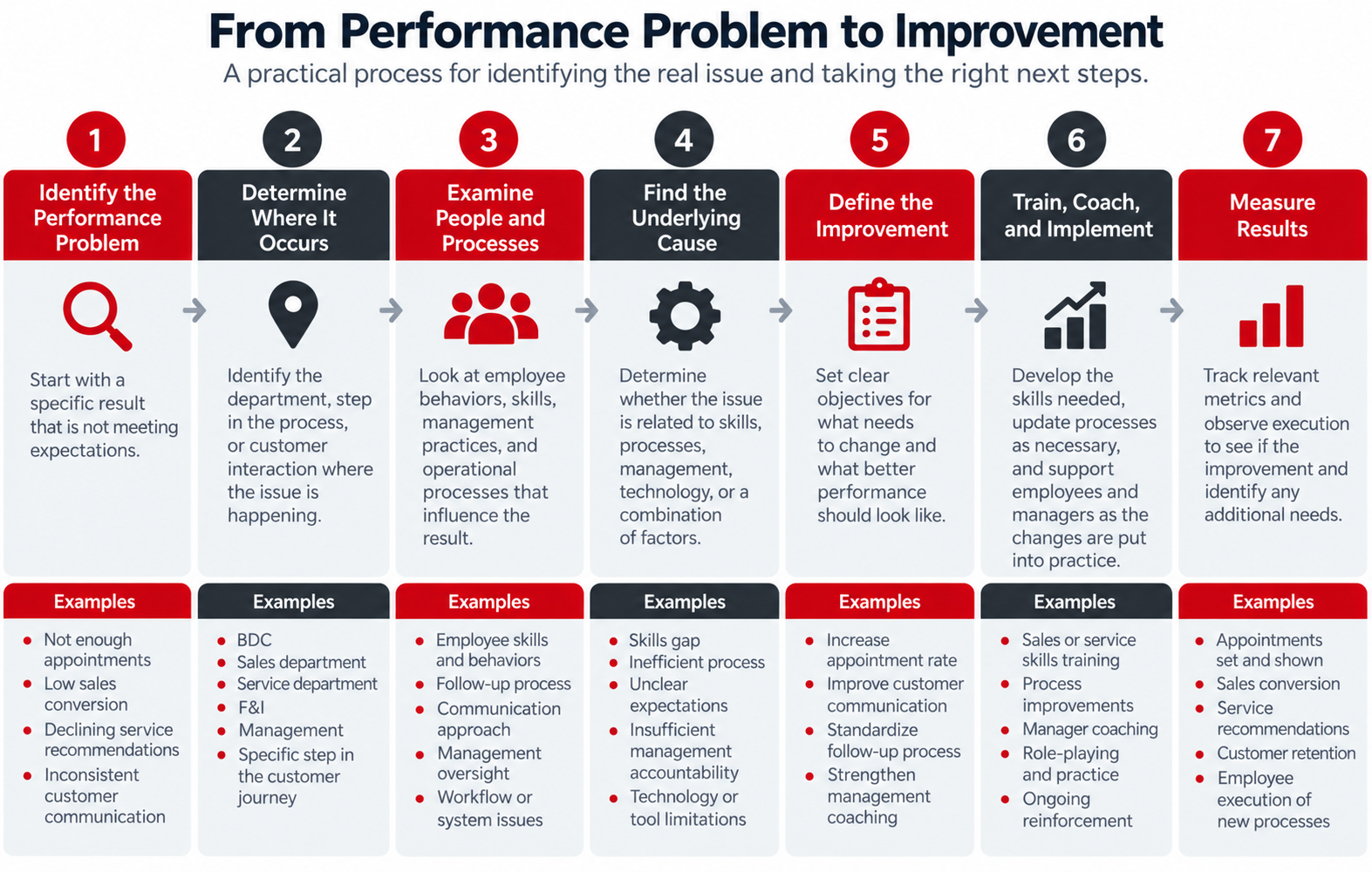
“We need to sell more cars” tells you what you want to happen. It does not tell you why it is not happening already. The same applies to broad concerns such as needing more appointments, better service performance, stronger customer retention, or improved productivity.
If appointment performance is weak, for example, you may need to look at several stages of the process. Are leads being contacted promptly? Are employees having productive conversations? Are appointments being confirmed? Is customer information moving correctly between the BDC and sales team? Are managers reviewing activity and coaching consistently? Training one skill will not solve the problem if the real breakdown is somewhere else.
Looking at the complete process helps you avoid spending time and money on a solution that does not address the actual cause. Automotive training and consulting can help connect employee behaviors with operational conditions so your improvement efforts are directed toward specific performance gaps rather than assumptions.
Turning Knowledge Into Everyday Execution
Knowing the process and following it consistently during a busy Saturday are two different things. An employee can understand an effective sales technique, service process, or customer communication strategy in training and still struggle to apply it when phones are ringing, customers are waiting, and several priorities are competing for attention.
That is why useful automotive training and consulting needs to connect learning with execution. Practice, observation, feedback, coaching, and management reinforcement give employees opportunities to turn concepts into repeatable workplace behaviors.
It also helps to have realistic expectations about change. One training session can introduce a skill or process, but lasting improvement generally requires reinforcement. Managers need to monitor execution, employees need opportunities to practice, and dealership leadership needs to continue supporting the standards it expects people to follow.
Measuring the Impact of Automotive Training and Consulting
Attendance does not tell you whether training worked. Before making an investment, identify the performance issue you are trying to improve and establish where the dealership stands today. That gives you something meaningful to measure after changes are introduced.
The right measures depend on the department and the problem. Your BDC might examine contact, appointment, show, and conversion performance. Sales management may look at lead handling, follow-up, appointments, and sales outcomes. Service leadership may evaluate measures connected with customer communication, recommendations, retention, or repair-order performance.
The numbers should also be considered alongside employee behavior. If results are not improving because employees are not following the intended process, more coaching or reinforcement may be necessary. If your team is executing the process correctly and the numbers still are not moving, that tells you something different: the process itself, or the original diagnosis of the problem, may need another look.
What Should You Look for in an Automotive Training and Consulting Provider?
A provider should understand how dealerships actually operate and the specific functions it proposes to improve. General business principles have value, but dealership sales, service, BDC, F&I, management, and office operations each come with their own workflows, customer interactions, performance measures, and operational pressures.
Before choosing a provider, look at how it approaches your business. Does the program account for your existing processes and goals? Is the material relevant to what employees actually do? Will your team have opportunities to practice? Are managers involved? Is there a plan for reinforcing improvements once the initial training is finished?
You should also understand what implementation will require from your dealership. Training takes employee time. Process changes require management involvement. Sustained improvement may require coaching, measurement, and continued reinforcement. Those commitments deserve consideration alongside program content and cost because even a strong program will have limited value if your dealership cannot support what happens afterward.
Building Better People and Better Processes
If you are evaluating automotive training and consulting, start with what is happening inside your dealership. Identify where performance is falling short, determine which behaviors and processes are contributing to it, define what better execution should look like, and make sure employees and managers have the support needed to maintain those improvements.
When development is tied to actual business needs, training becomes more than an educational exercise. It gives your dealership a practical framework for building more capable employees, creating greater consistency between departments, and improving how the operation performs day after day.
Turn Better Processes Into Better Performance
The value of automotive training and consulting comes from connecting employee development with the way your dealership actually operates. Strong skills are more valuable when employees have clear processes in which to apply them, and strong processes work better when your people understand how to execute them consistently.
This is reflected in the services offered by Automotive Training Network (ATN), which provides automotive training and consulting alongside other dealership support services. Its current training options include virtual programs, bootcamps, and in-dealership workshops, with programs covering areas such as sales, BDC, digital lead management, and dealership operations.
Key Takeaways
- Automotive training and consulting can strengthen both your people and the processes they follow.
- Consistent processes give managers clearer standards for coaching and employees clearer expectations for execution.
- Effective training should address specific dealership needs rather than provide information without a connection to performance.
- Management reinforcement helps employees turn what they learn into everyday behaviors.
- Measuring both results and execution helps you determine what is working and where additional changes may be needed.